
1I have had a change of viewpoint regarding the true meaning of quantum mechanics and I am now a complete convert to the Many Worlds Interpretation, which I argue follows from and is completely equivalent to the Feynman sum over histories version of quantum physics. Please take a look at the concluding sections of this post. Since it all came about from the chain of reasoning below, I am retaining it, but I now believe MWI offers a more satisfactory explanation of quantum phenomena than the Copenhagen interpretation.
Standard lore regarding the wave function in quantum mechanics is somewhat flawed. It is defined as giving the probability amplitude for finding a particle at a certain position, which is all well and good, but then some people say that the particle exists at all the different points at once in a certain sense, alluding in other words to a tangible cloud, which permeates spacetime, which is manifestly false. Not in the Copenhagen interpretation (CI) though, those guys are clearheaded about what they mean by the wave function, they say it’s fictitious, a mere tool that aids in discerning the consequences of an experimental process, and no more, that it doesn’t mean anything to attach any physical meaning to it. Further that, doing so has its own pitfalls, for instance consider the Young’s double slit experiment. There’s no way you can explain what’s going on by taking recourse to the dynamics of a spreading wave that’s anything apart from a fictitious wave of probability as espoused by the CI. Such a wave is not made up of anything tangible, it’s just a mathematical function that happens to be convenient in describing what is going on. There’s no way to attach any physical reality to such a thing. In particular, it makes no sense to speculate on what the particle is doing as the wave function propagates from source to screen, which is why Bohmian mechanics is wrongheaded. For all practical purposes the particle doesn’t exist until and unless an observation is made. This was deeply disturbing to Einstein and we will see in what way it makes sense, in other words, we will provide a credible story for it.
But the Copenhagen guys agree that they have trouble explaining wave function collapse, namely how it takes place and what happens when it takes place. Arguably, Bohr never came up with a satisfactory answer to Einstein’s question as to what happens to the rest of the wave function when a particle collapses at a certain point in spacetime. How do the parts of the wave function that are spread out far away from the point of observation instantaneously vanish? Why doesn’t that violate the principle of relativity which forbids faster than light propagation? In fact this was the line of thought that led to the formulation of the EPR paradox somewhere down the line.
The trouble in our opinion lies again in conflating the wave function with something tangible and existing in some physical form at all points in spacetime. Whereas what’s really going on is that it is really the manifestation of a vector in Hilbert space. The relationship between the two is well known. It’s given by
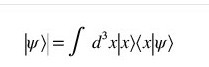
The left hand side represents the Hilbert space vector, while the inner product on the right hand side is the wave function. This is the same relationship between an ordinary vector and its components. The position ket vectors are the unit vectors on the rhs and the wave function is the component along |x>.
Now consider the electric field vector for instance. At any point it points in a certain direction. But does it make sense to say that the different unit vectors and the components which lie along them have separate existences of their own, no, for they are completely basis dependent. Similarly it makes no sense to say that the |x>’s and the wave function have separate existences on their own. Just like the electric field components they are merely mathematical fictions, and what is real is the Hilbert space vector on the lhs above. An observation process acts like a filter in that it selects a specific direction in Hilbert space delineated by some |x>, and the probability amplitude for such a selection is given by the wave function at that x. It’s akin to a polarizer letting only a specific component of the electromagnetic field through. The other components then cease to have any significance, for they were fictitious to start with in any case. Let’s now see what bearing that has on the paradigm of wave function collapse.
“Wave function collapse” is thus just the same as the process of polarization in Hilbert space. It’s not as if the vector collapses at a certain position, merely that only a certain component is let through, and the rest of the wave function, aka the other components, cease to matter, since they were fictitious to start with, as above. The question that then arises is how do you see a whole particle, and the answer is that it’s akin to photons passing through a polarizer, which they do depending upon the magnitude of the electromagnetic field component along the polarization axis. The same thing is at play in Hilbert space. Depending on the component at a certain point, which is nothing but the wave function, the particle manifests itself by “passing through” |x>. Actually, in the right way of looking at it, all points in spacetime are imbued with the possibility of a particle manifestation via |x>, and from time to time such a thing happens. It’s a spontaneous process solely dependent upon the value of the wave function and we would like to suggest that in no way does it make sense to say that the original particle that sets out from a source actually is the same particle that is observed in the detector. The two are conflated on account of the fact that the particles happen to be identical because of their indistinguishability arising from the nature of the underlying quantum field theory and the fact that particles are in reality excitations of the quantum field. Between observations since the state exists as a linear superposition of basis states, the particle simply doesn’t exist anywhere in spacetime. Conflating this with the notion as Einstein did, that it doesn’t make sense to say that the moon doesn’t exist when one is not looking at it, is a wrong reading of what quantum mechanics is trying to say.
When a photon is made to pass through a polarizer, the standard interpretation is that the wave function collapses to the polarized state. But that's an unnecessary assumption. All that needs to happen is a component of the state vector, which is an object in Hilbert space is selected in the process. The fallacy of the canonical approach lies in assuming that the whole Hilbert space vector gets reoriented in the new direction, aka wave function collapse, whereas it's enough to assume that only its component passes through. People get confused because indeed they see a whole particle in their detector and not a part thereof and jump to the conclusion that that can only be if the state has reoriented itself fully in the direction of polarization, for there's this thing known as the norm of a state and it has to be maximal in order for a particle to manifest itself, or so goes the standard lore. But that is fundamentally flawed. What happens is only a component goes through and it determines the probability of a particle excitation manifesting itself in the detector, something brought into being by the quantum field acting on the vacuum at that point. If the whole vector went through, there would be no difference in how often you would find the particle, you would find it every time you looked for it. People will then say that the probability of detection is decided by the probability of collapse to the polarized state, and all I am saying is that is an unnecessary assumption. For what I said above has the same effect. And it has the advantage that you don't have to assume that the wave function collapses. And this entire paradigm applies to Hilbert space polarization as well. When you are observing something in spacetime, you are filtering through a specific state |x>, representing a particle at x, whose probability amplitude is given by the wave function, but in no way is it necessary to assume that the whole state vector reorients along |x>. Note that by this you are really truncating the initial vector, akin to what happens in polarization, but that's OK, due to what we said.
Let’s now see how all that comes about, borrowing from a paper in preparation. Since it involves particle creation, one has to invoke quantum field theory, replacing Hilbert space states with Fock ones, however, still recovering quantum mechanics in the end, in the non-relativistic limit.
Invoking quantum field theory:
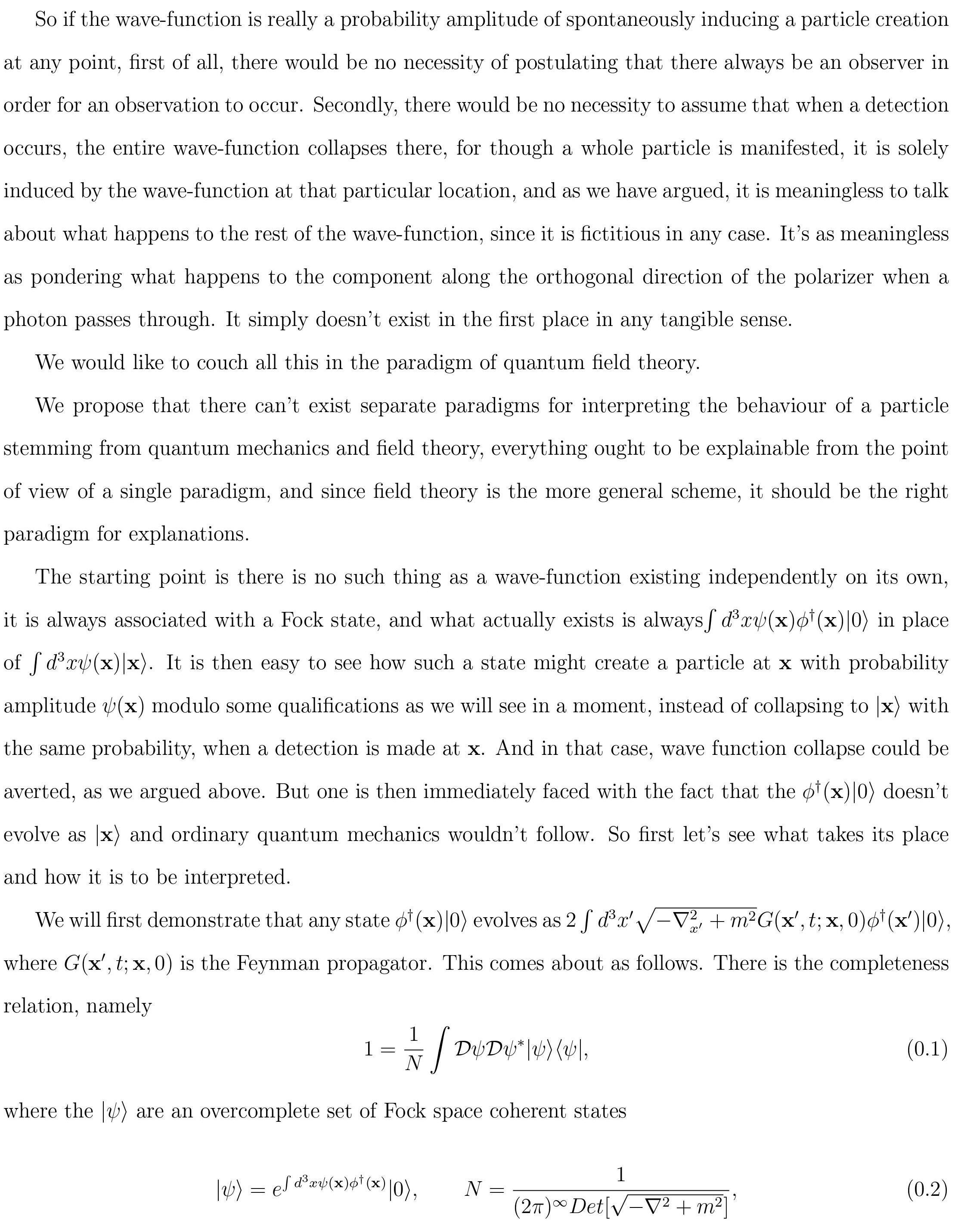
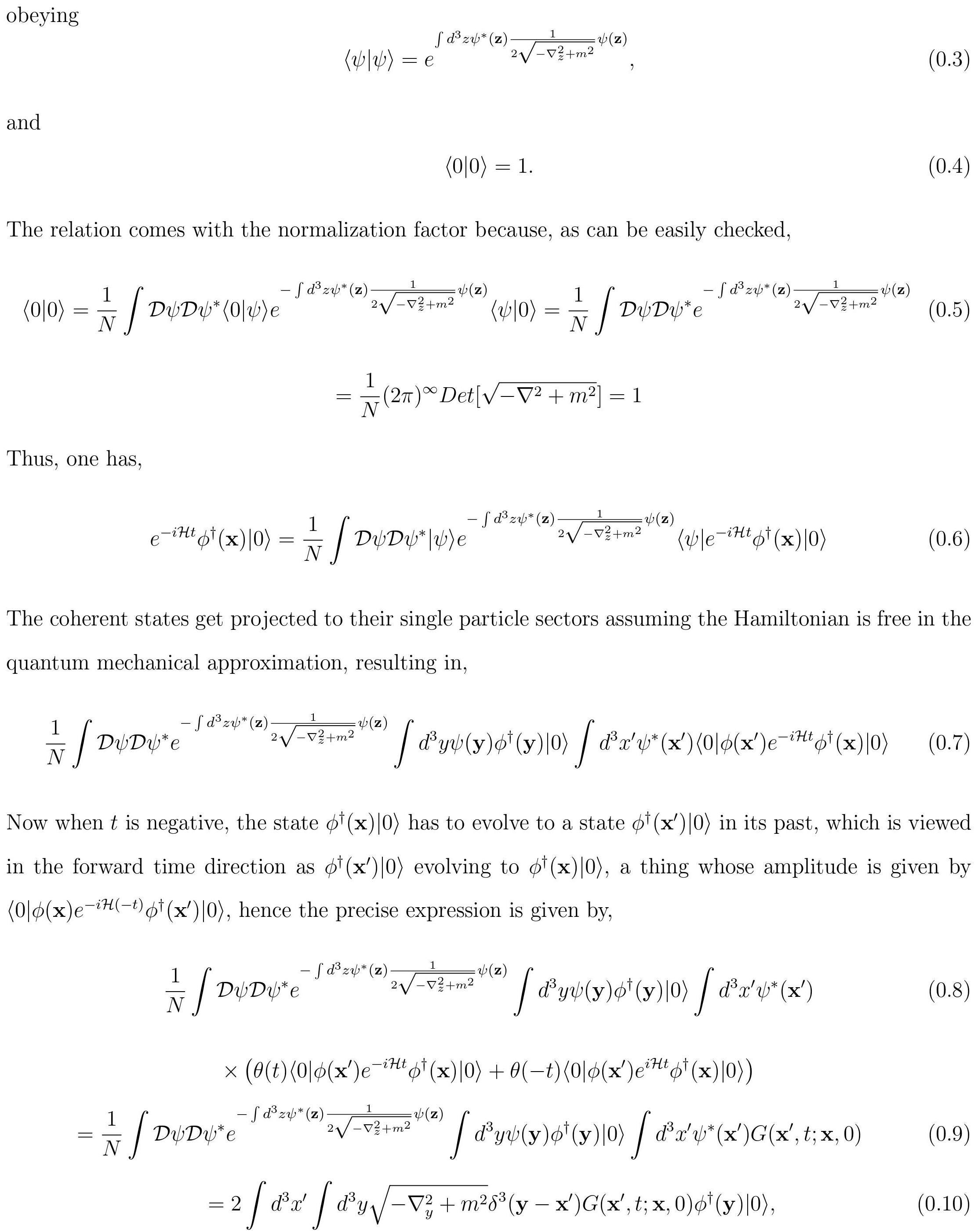
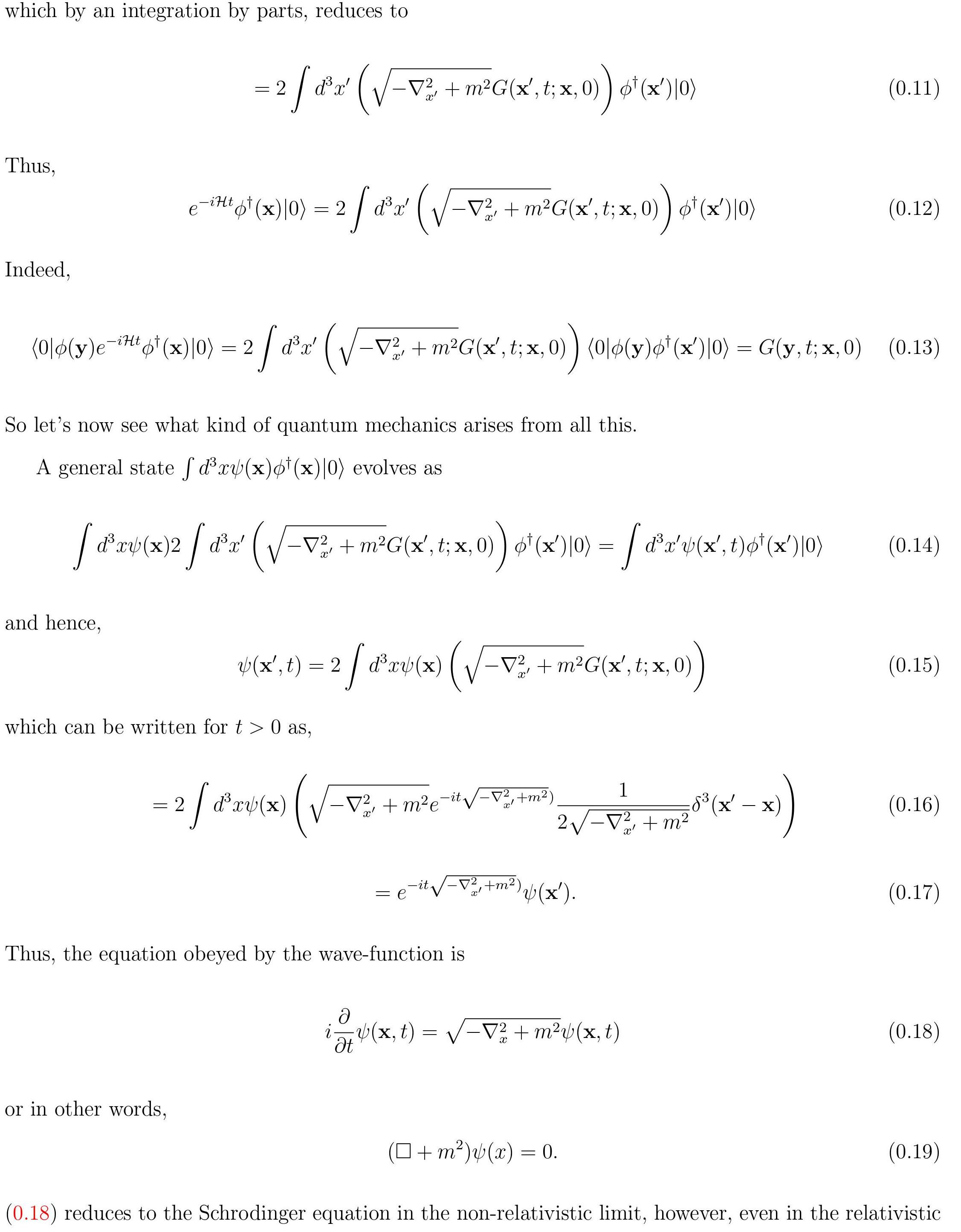
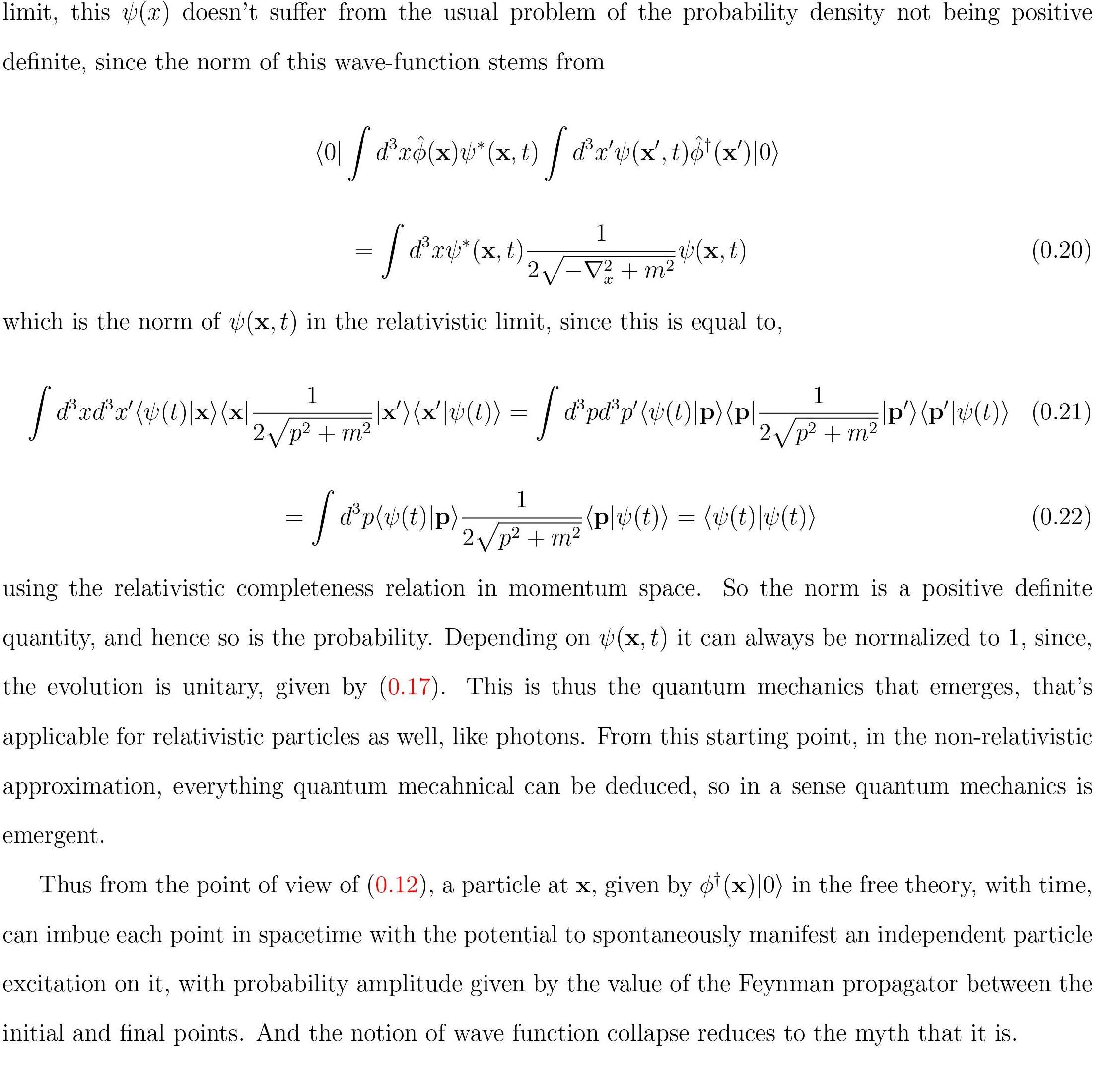
There’s an obvious typo in Eq.(0.1) in that the weighting factor hasn’t been included. There’s also a typo in the equation preceding (0.9) in that x and x’ ought to be swapped in the second term.
It might appear that the evolved state (0.12) is finally collapsing to the particle state at y in (0.13), but as we said it is to be interpreted as a filtration in Fock space. (0.13) measures the probability amplitude that such a filtration actually takes place, but that in no way implies that once that occurs the original state collapses to the final state. Moreover, as we said, it’s meaningless to speculate on what happens to the other components once such a filtration takes place, much as in a polarization process.
Thus there’s no collapse of the wave function and its associated mysteries as conceived by Einstein and Bohr had been right all along. In fact there’s no mention of wave function collapse in all of Bohr‘s writings, but admittedly, they were somewhat obscure. The EPR paradox can also be easily explained away in this paradigm, as we will presently do. Also the Many Worlds and other spurious explanations can be retired, for all of them try to explain away the nonexistent phenomenon of wave function collapse. And as well, the role of the observer, decoherence, the whole shebang, is rendered immaterial.
Spooky action at a distance and the death of spacetime:
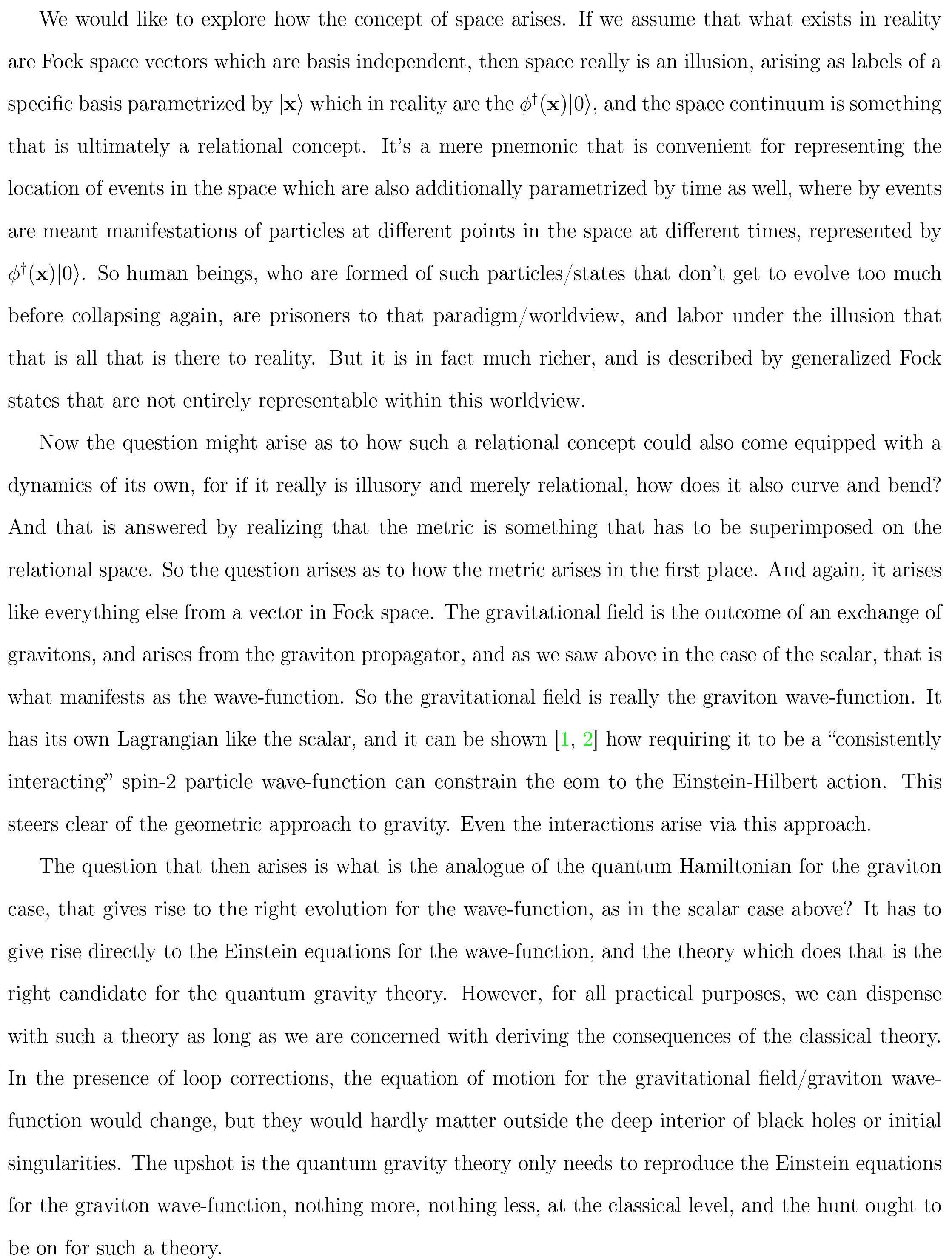
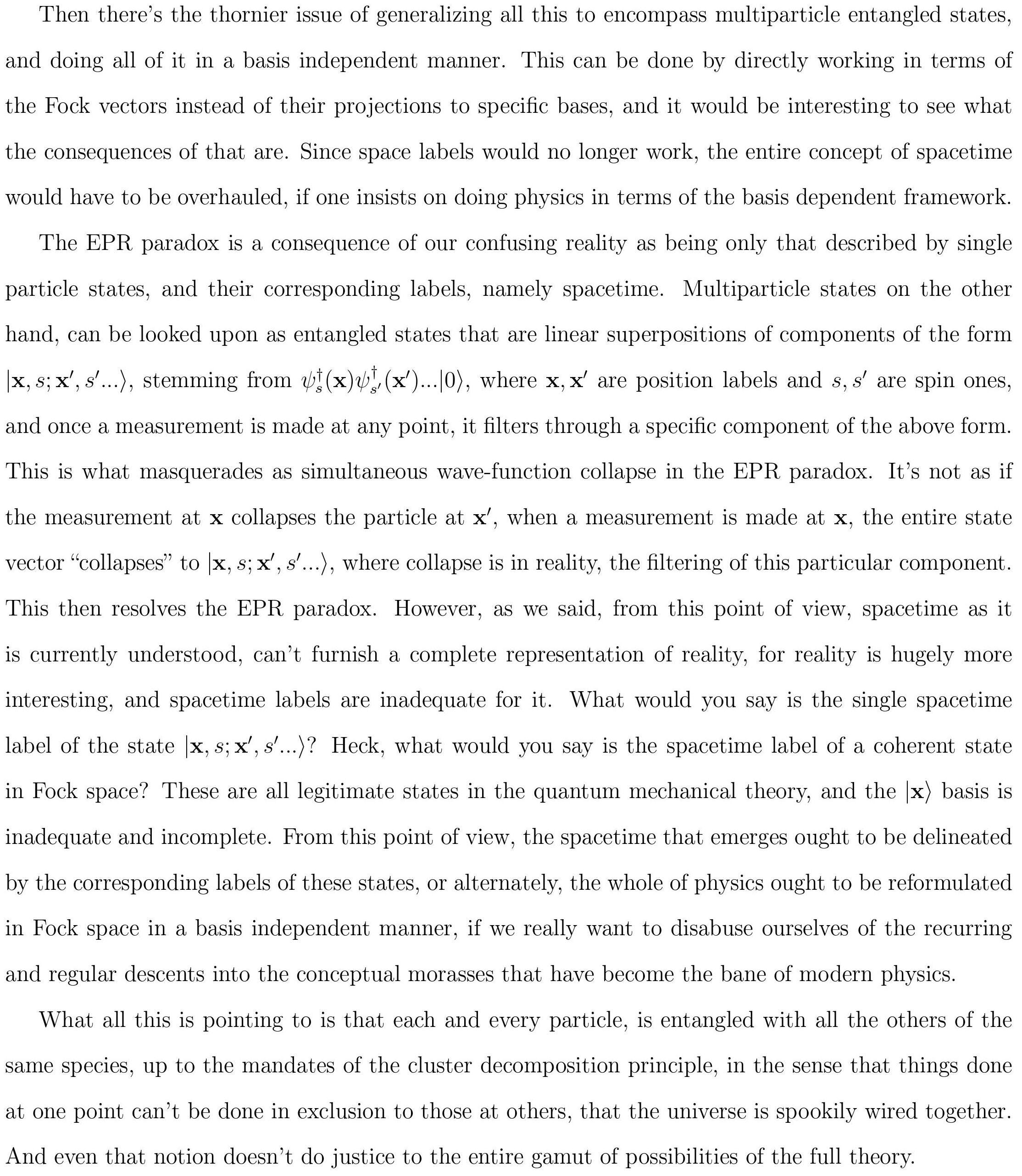
BTW, string theorists might be on to something here.
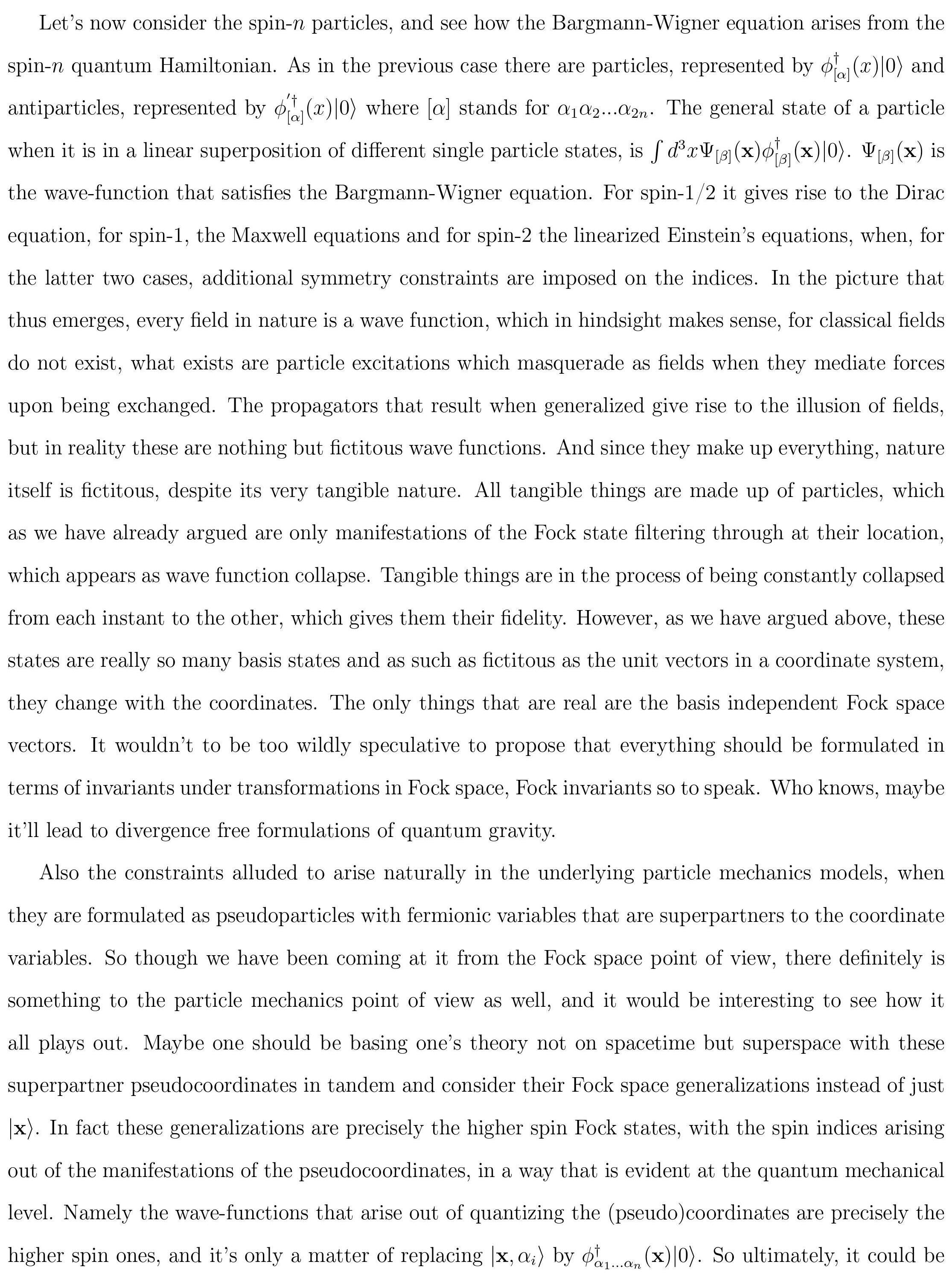
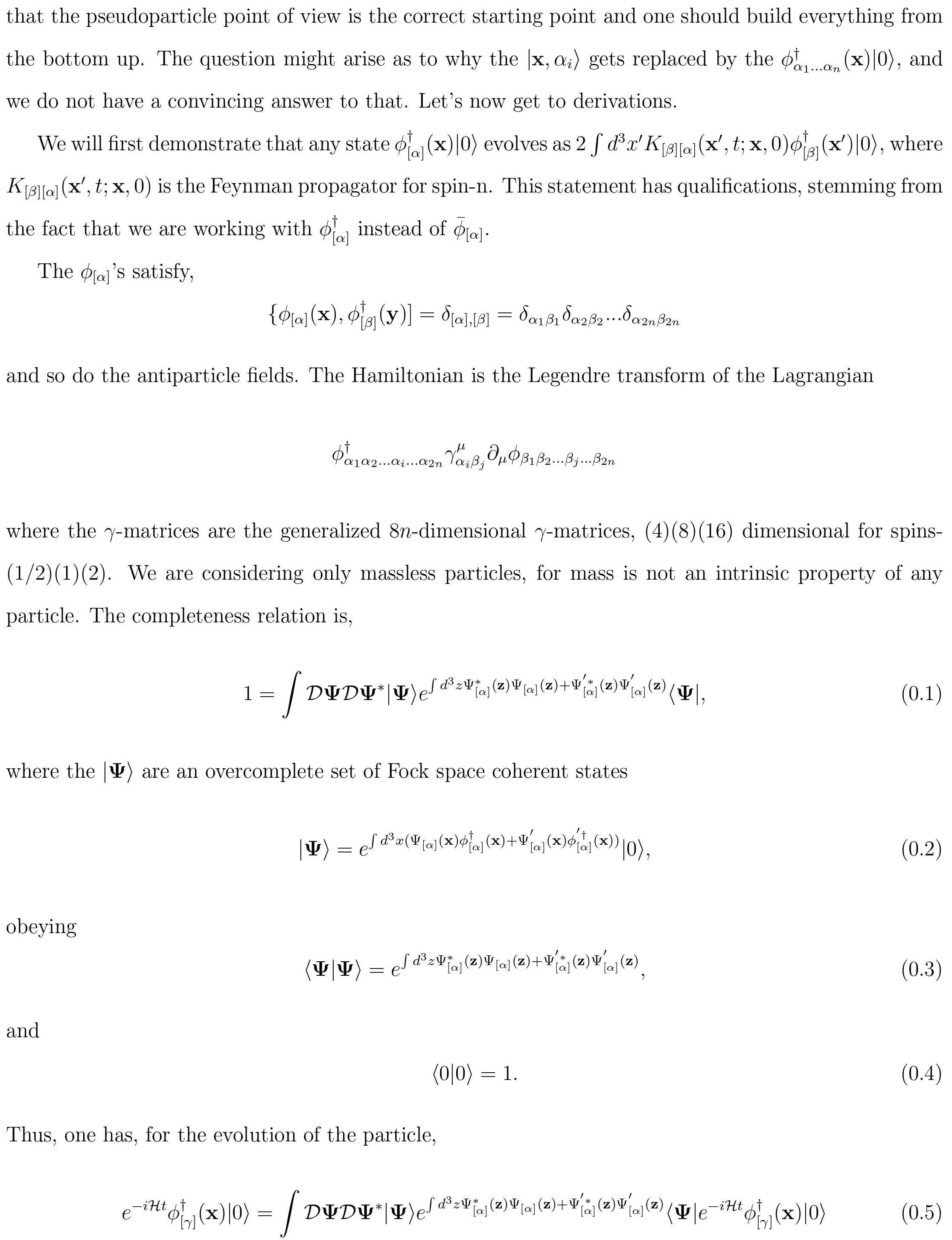
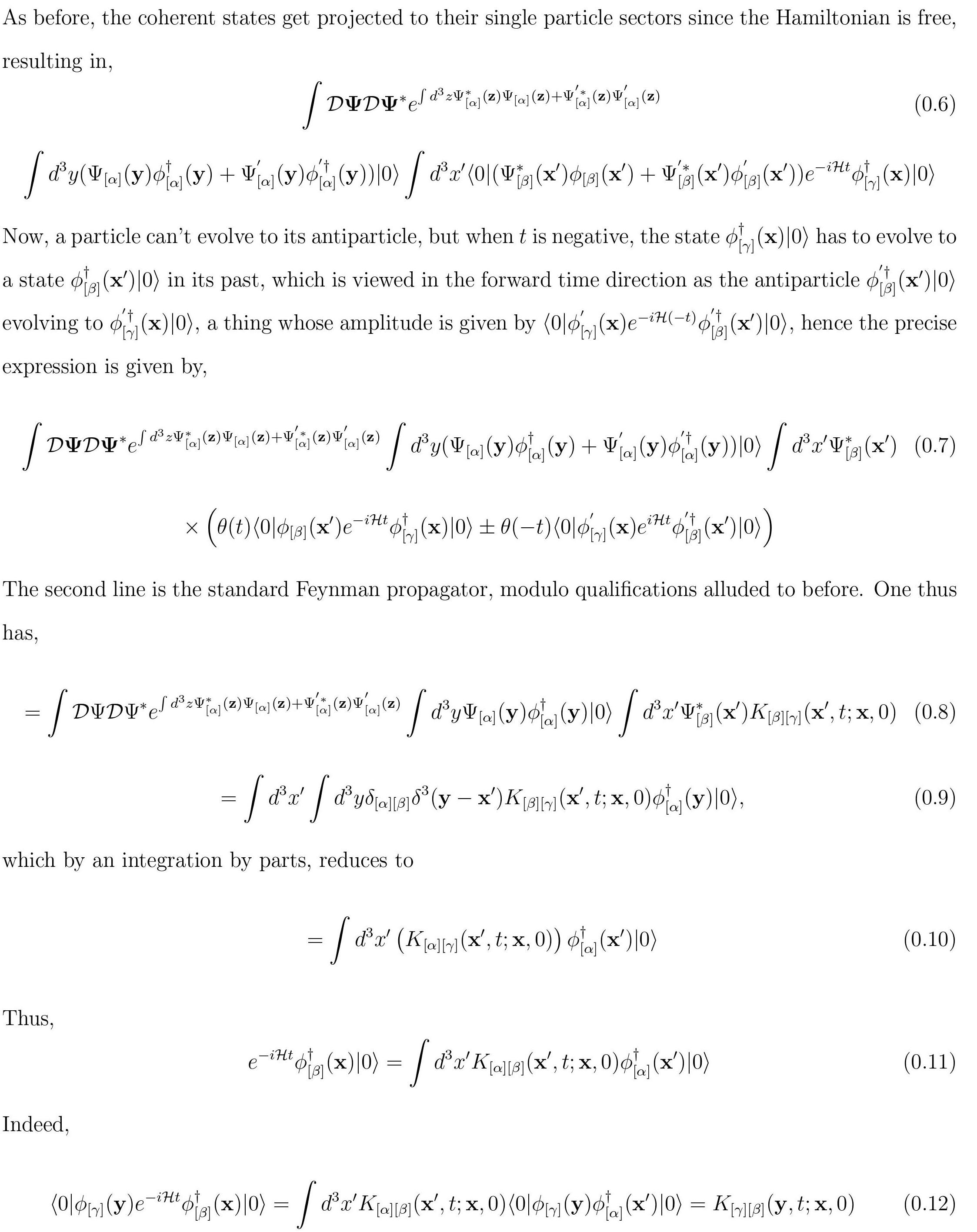
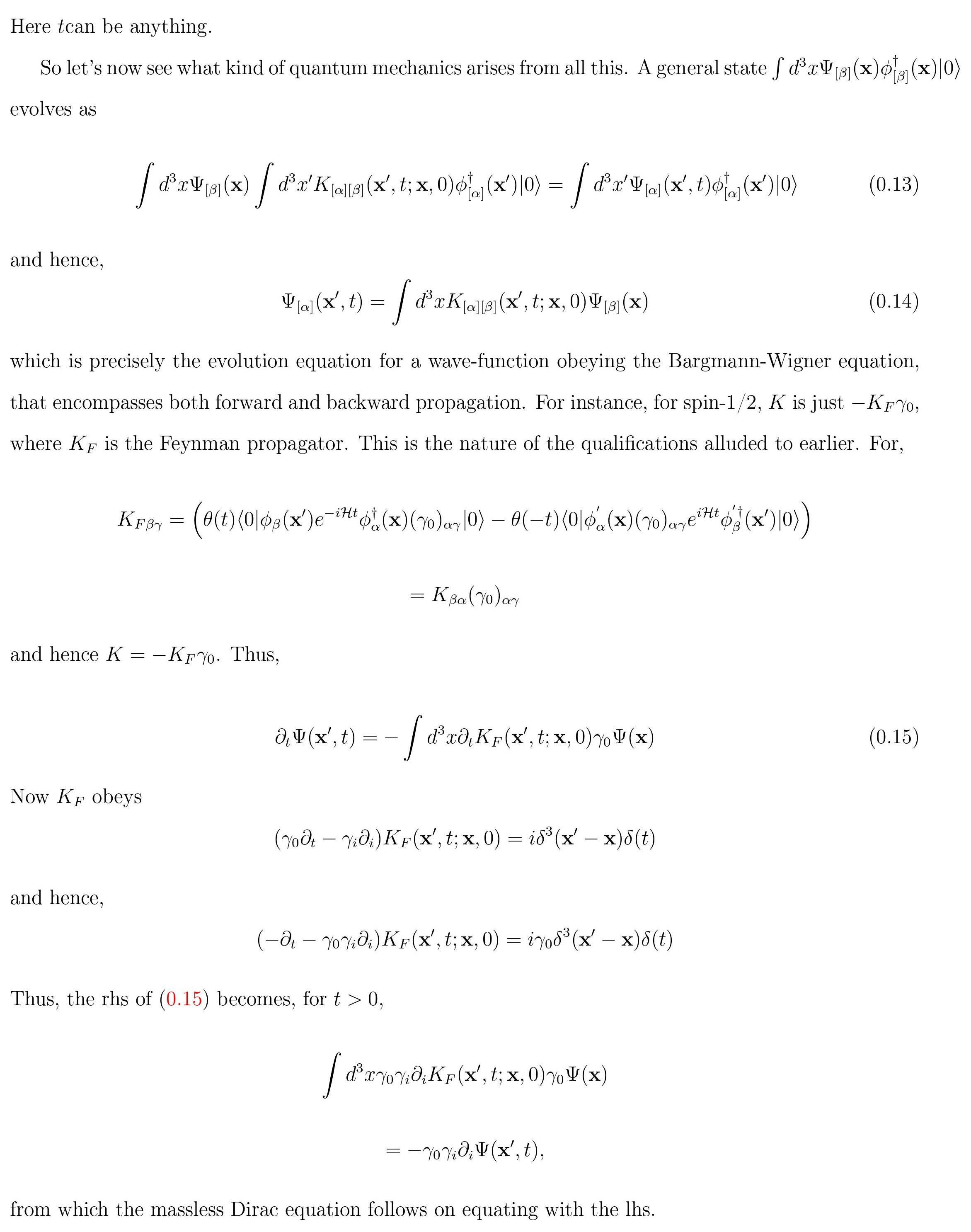
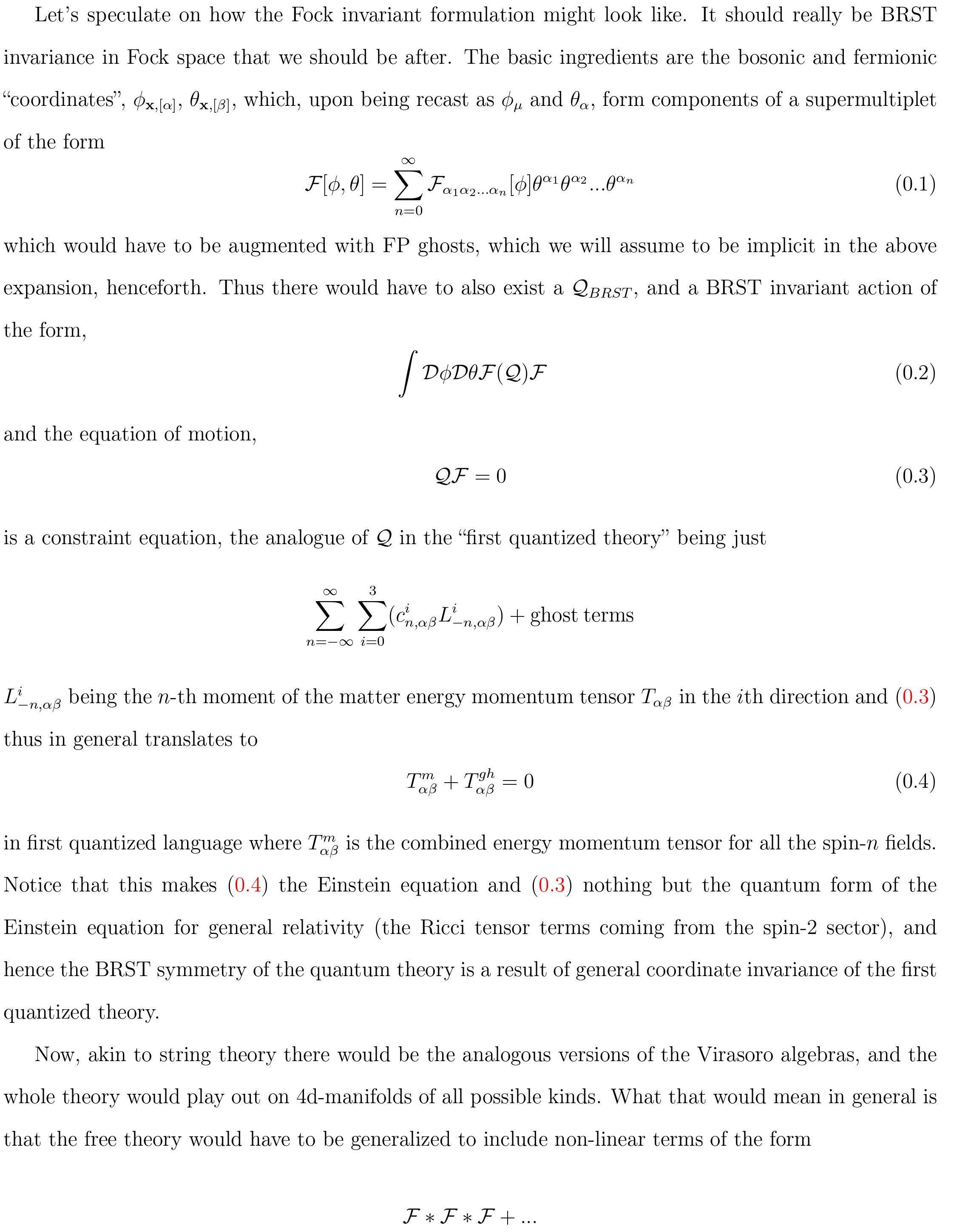
Now, here’s how the formalism should be generalized to include everything in nature and what it means:
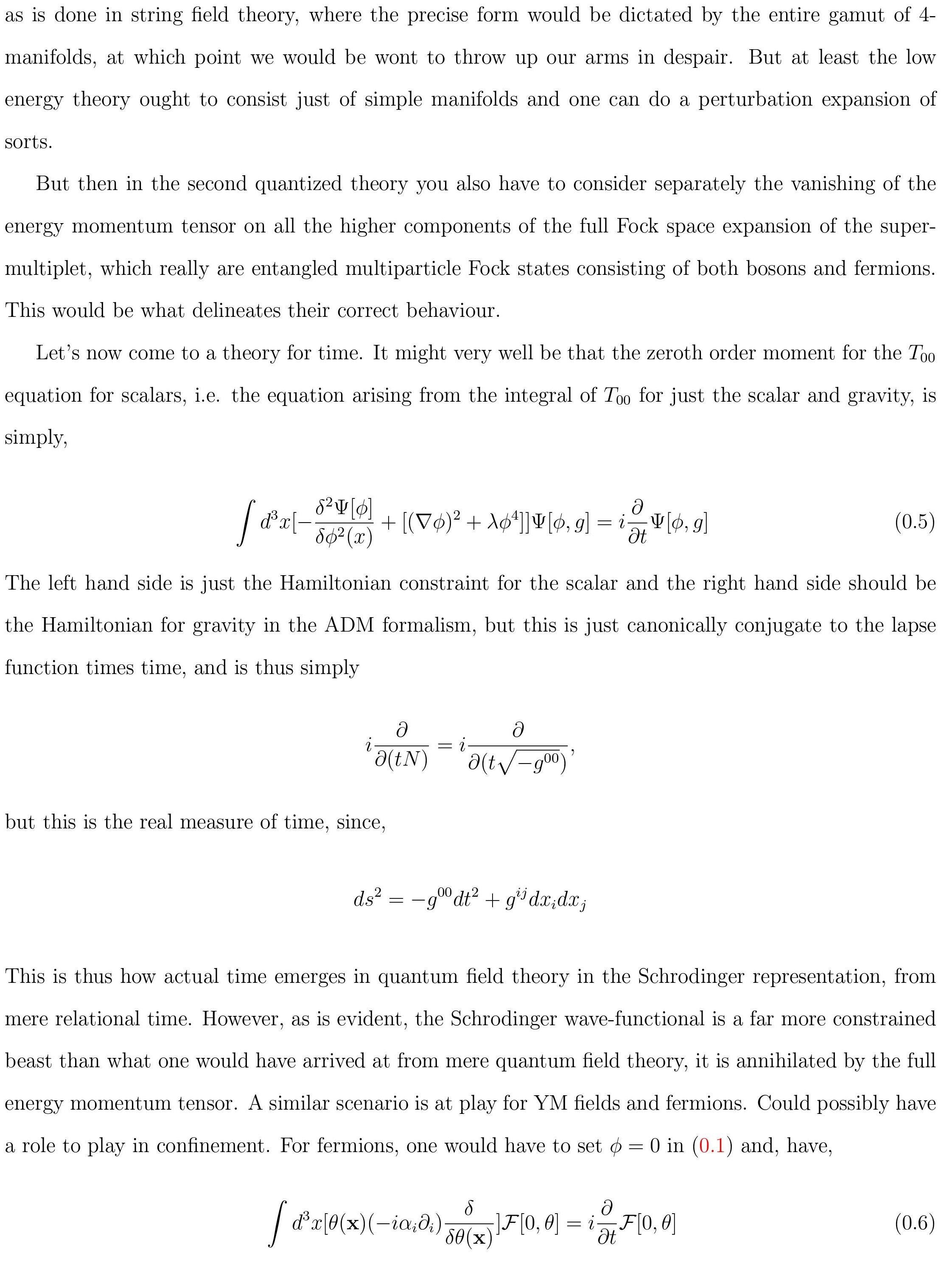
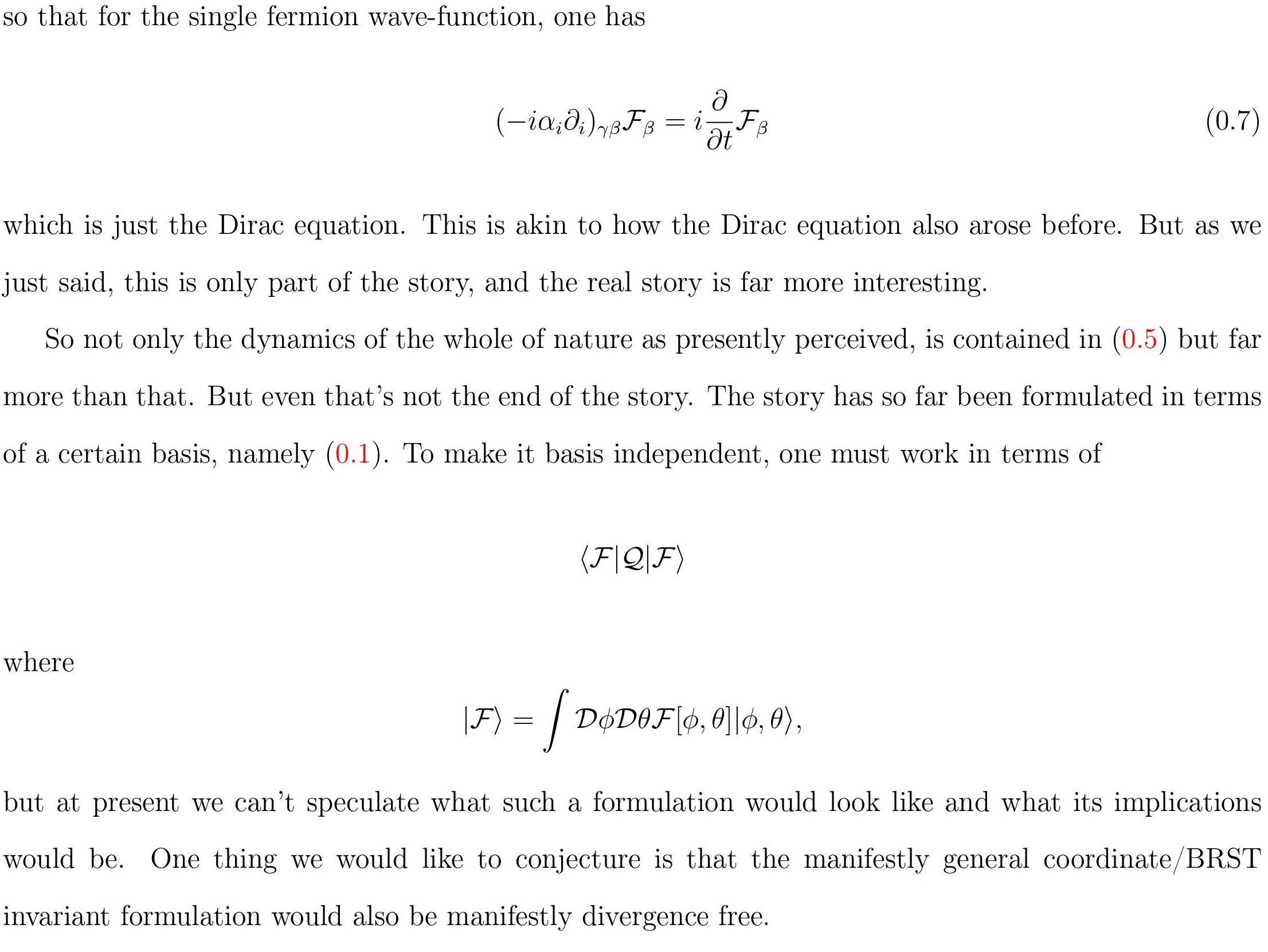
Rescuing physics from singularities and divergences:
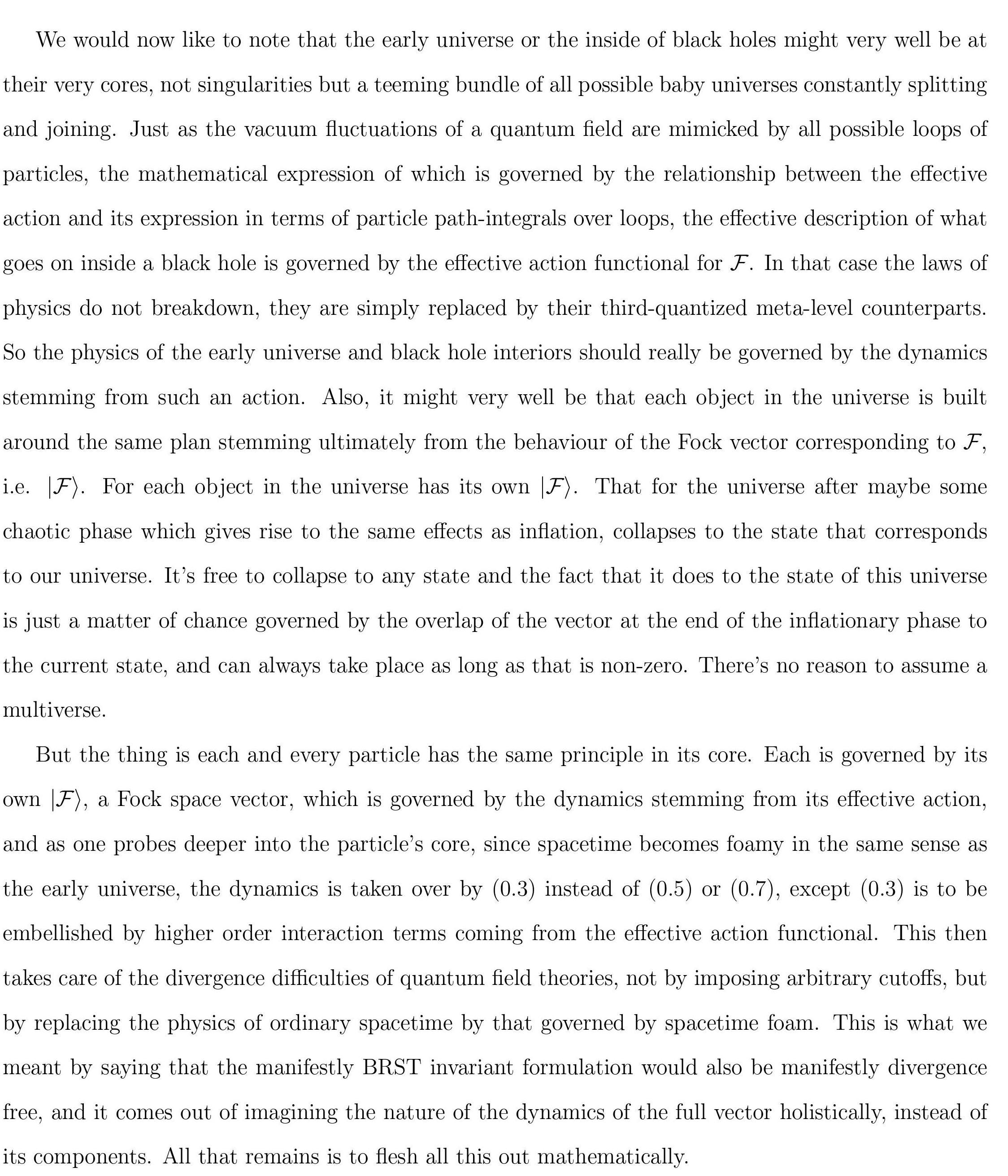
This is the rough outline of how it would come about mathematically.
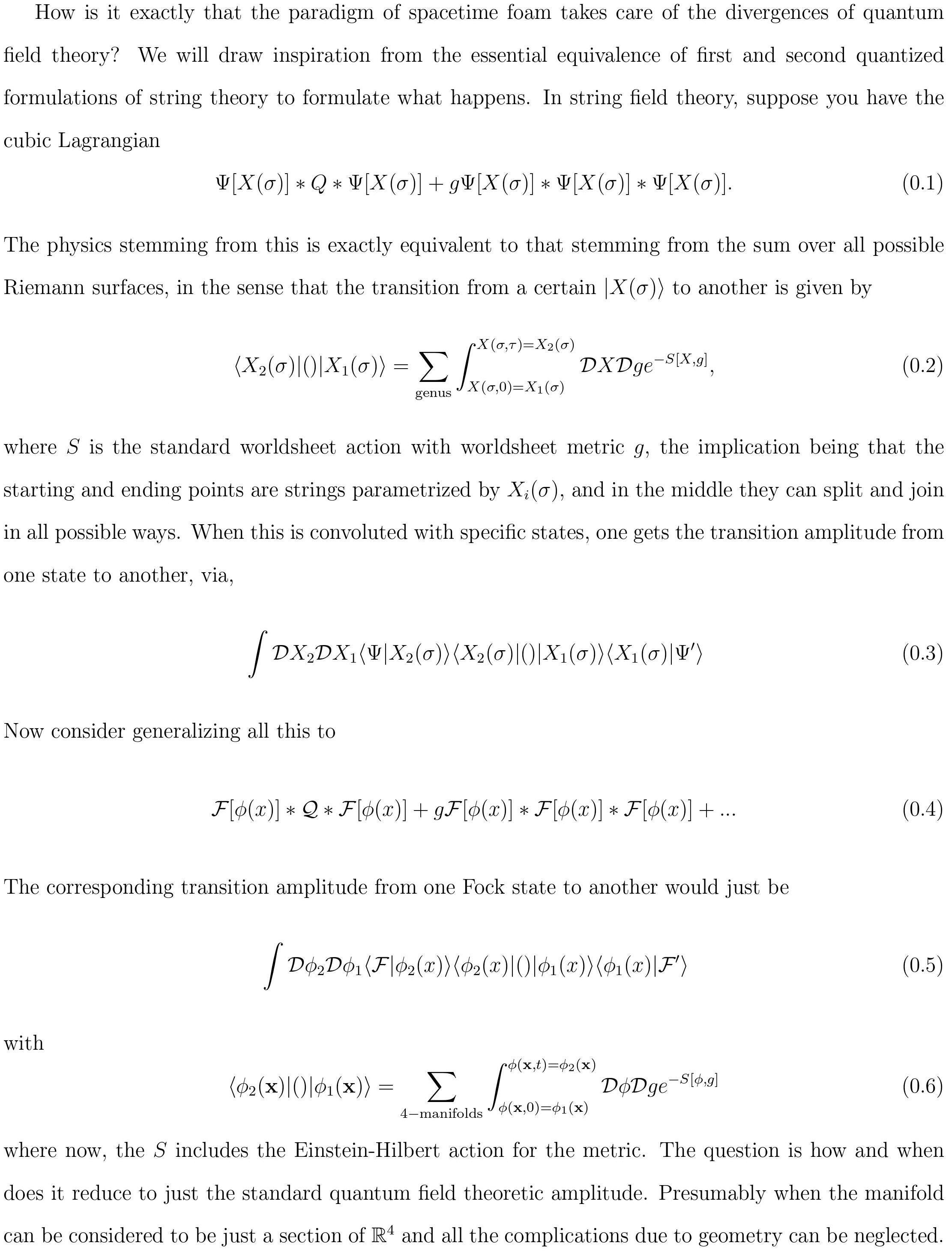
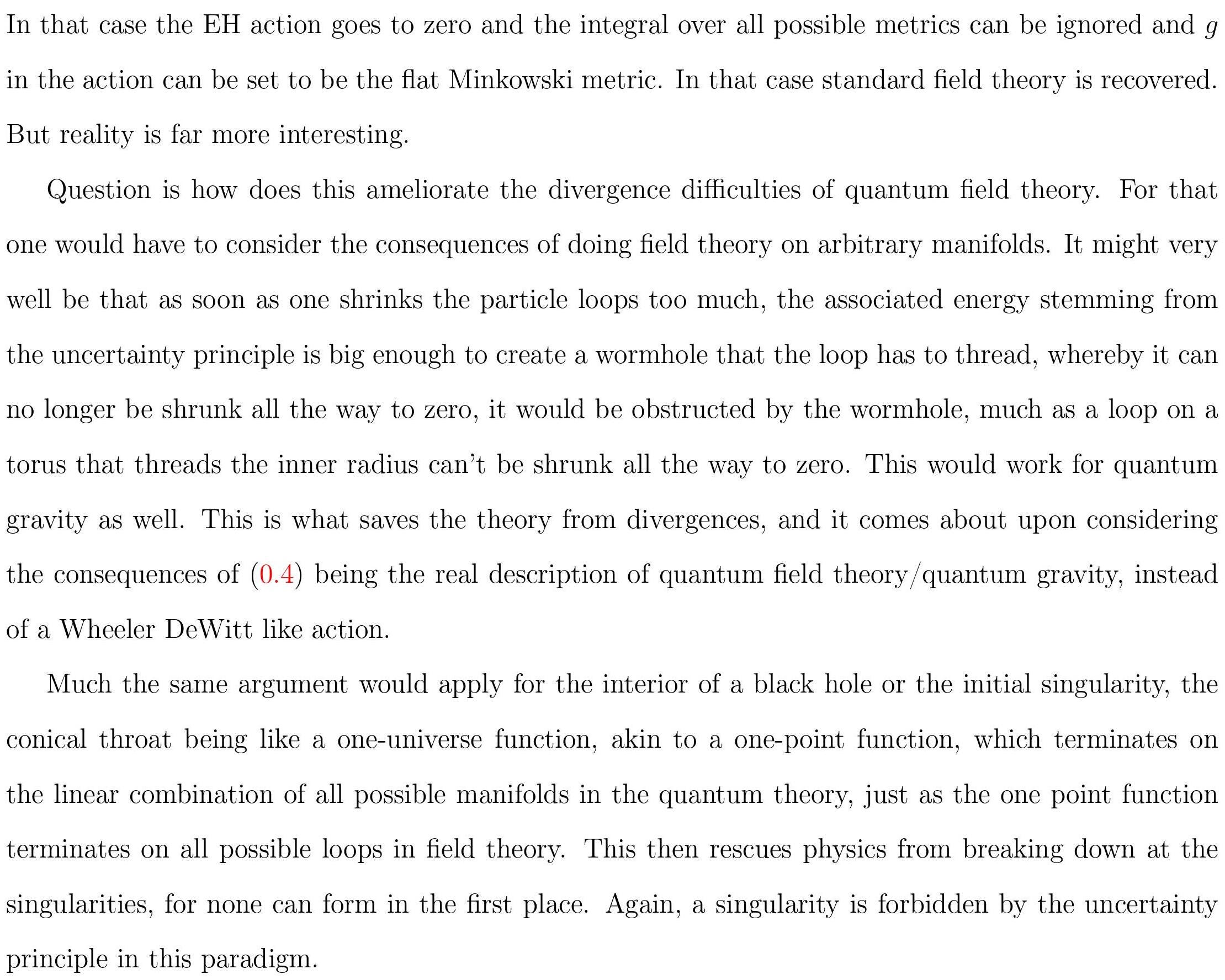
Why all this is equivalent to the Many-worlds interpretation, and in a sense to QBism as well:
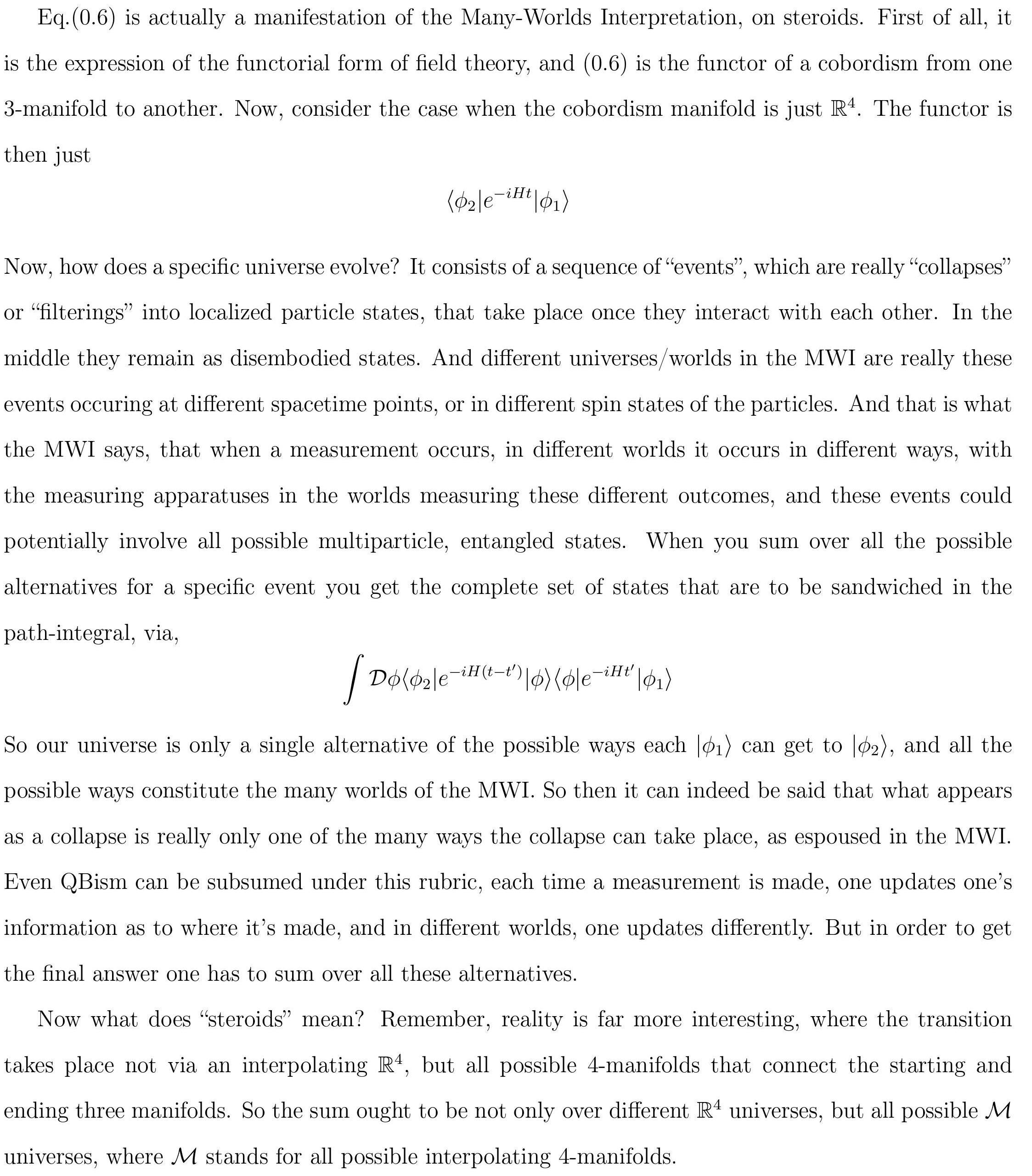
The true demystification of quantum mechanics:
Notice that this then takes care of the Schrodinger’s cat paradox, in each universe the cat is in a specific state, ie. either dead or alive, the only difference in this view of looking at things is that it is not contingent upon the observer opening the box to look, it happens as soon as the radioactive substance is released. In fact in this case, it is not just two separate worlds into which the splitting occurs, the different times of the release of the radioactive substance constitute different events and together with multiple such releases at the same point in time constitute the intermediate states in the expression above. And all these different events can be thought of as occurring in different branches of the universe, so in a sense the intuition that the MWI is equivalent to the sum over histories version of quantum theory makes perfect sense. And since the whole of quantum theory can be interpreted in terms of path integrals, everything has a MWI. And finally, that is what leads to the complete demystification of quantum mechanics.
For instance in the Young‘s double slit experiment in different universes the particle goes through different holes but nevertheless in order to get the final probability amplitude you have to sum over the effects. The question might arise as to what happens to the sum over multiparticle states in this case, and the answer is that since the initial and final states are single particle states and the Hamiltonian is free, the transition to multiparticle states in the middle doesn't occur and the system behaves as a quantum mechanical system and is hence approximated to utmost accuracy by quantum mechanical path integrals. In any case the entire confusion as to how can the particle can travel through both slits at once is brought to rest since in a given universe the particle travels through a single slit only. This is also the way I believe David Deutsch interprets it as well.
Brahman:
Brahman is precisely like the fwave function of quantum mechanics. It’s a unique pristine vector and the universe is the result of its unfolding evolution, whereby just like the evolving Fock space vector, it imbues each spacetime point with the potential of its manifestation. Except, instead of single particle states, one has to now consider the entire gamut of multiparticle states, so that all (un)entangled entities of the universe are now brought under its purview. From Brahman’s point of view these are all fictitious and yet from the deluded perspective of an Einstein they appear to be real, and all of mankind is in the position of Einstein. These fictitious components are what make up the universe. They owe their existence to Maya or illusion, but in reality only the single vector exists, and the components are merely its ephemeral projections. Each component has the potential of manifesting Brahman, and hence, each entity of this universe is potentially divine. From the humble electron to a Ramakrishna, each entity of the universe is a portal for the entry of Brahman, it’s just a matter of the magnitude of the wave function along it. Thus the two differ not in kind but only in degree. And that applies to the rest of us as well, which is why we are all essentially the same, being merely different projections of a single vector. We just have to transition from the point of view of Einstein to that of Bohr.
This is why natural laws and those governing the soul stem from the same source, the nature of Brahman, pointing to the unity of the laws of the microcosm and the macrocosm, as espoused by Swamiji. For the nature of the electron is the same as that of the soul of man, since they’re both components of Brahman. In order to crack AGI, we need to first crack consciousness, and hence, for that we need the source code for nature. But she is still unraveling, we don’t yet know what her whole particle spectrum is, with tantalizing hints coming from ongoing experiments and the fact that there is dark matter.
Interesting times ahead!
Glad to hear your musing...keep posting...